
What is Bagh Chal?
Bagh Chal — also written Bagchal or Bagh-Chal — is a traditional two-player strategy game from Nepal. The name is usually translated as “the tiger’s move” (bagh means tiger, chal means move), and in English the game is often called Tigers and Goats. There are no dice or cards: nothing is left to chance. One player controls four tigers and the other controls up to twenty goats, as Wikipedia’s entry on the game puts it, which makes the two sides play very differently.
The game needs almost no equipment. According to Thankot.com, a heritage-and-travel site run by researchers and residents based in and around Chandragiri Municipality, boards are often scratched into the dirt or drawn on shop steps, and pieces are improvised from pebbles or bottle tops.
The board
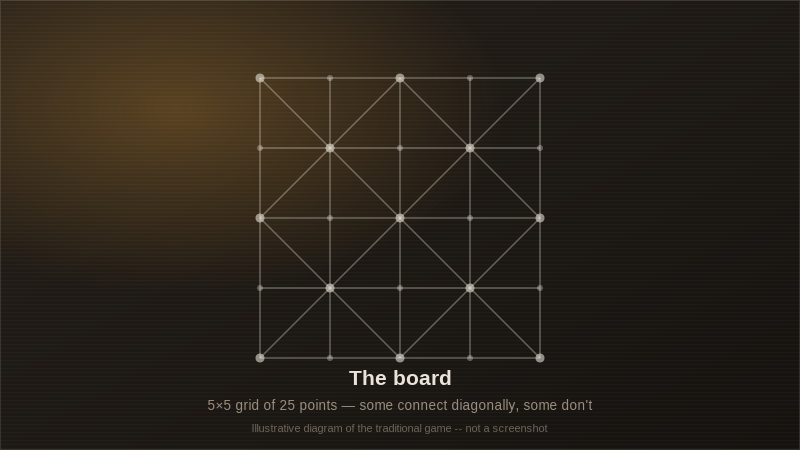
Bagh Chal is played on a 5×5 grid of 25 points joined by lines. As in alquerque, an older board game on the same kind of grid, the pieces sit on the points where lines meet — not inside the squares, as in chess.
Every point connects to its neighbours up, down, left and right. Diagonal lines are drawn only through every other point: in practice, along the two long diagonals and along the diamond that joins the middle of each edge. A piece can step or jump diagonally only along those lines. That makes the points where diagonals meet far better connected — the centre point and the four points diagonally around it have eight neighbours, while a corner point has only three.
Setup
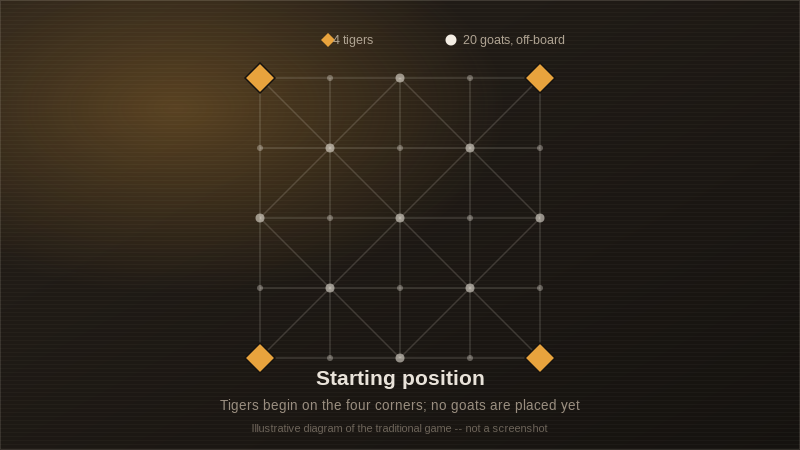
The tiger player puts one tiger on each of the four corner points. The goat player keeps twenty goats off the board, ready to be placed. The goat player moves first.
Phase 1: placing the goats
Play begins with a placement phase. On each of their turns the goat player puts one new goat on any empty point. Goats already on the board cannot move during this phase. The tiger player moves in between: a tiger slides one step along a line to an adjacent empty point, or captures a goat (see below). Tigers do not have to wait for the placement phase to end before they capture.
Phase 2: moving the goats
Once all twenty goats have been placed, the goats can finally move. From then on both sides alternate turns and every piece moves one step along a line to an adjacent empty point. Goats never jump or capture. A goat that has been captured is out of the game for good — it is not placed again.
How tigers capture
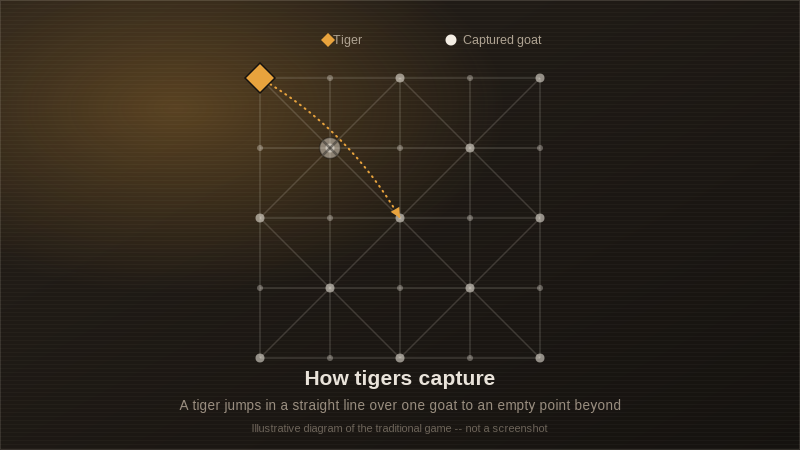
A tiger captures by jumping over an adjacent goat, in a straight line along a drawn line, and landing on the empty point directly beyond it. The goat that was jumped is removed from the board. A tiger takes one goat per jump, cannot jump over another tiger, and needs the landing point to be empty: if the point behind a goat is occupied, or if there is no point behind it at all (a goat in a corner), that goat cannot be jumped in that direction.
Capturing is not compulsory — a tiger may decline a jump, as Wikipedia notes.
How to win
- The tigers win by capturing five goats.
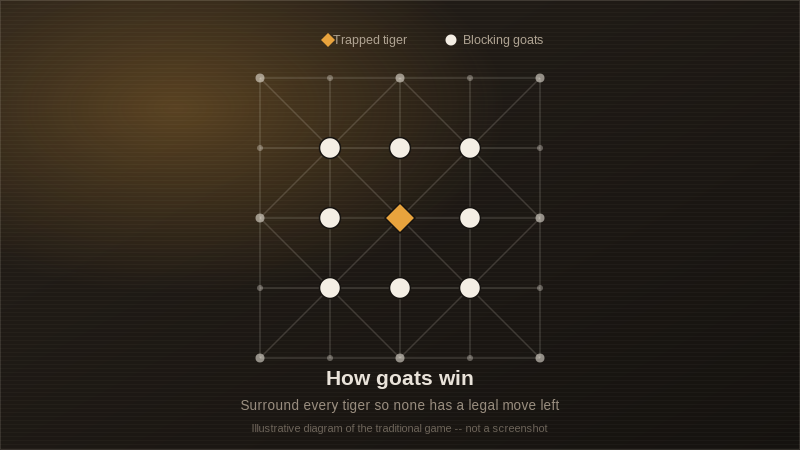
- The goats win by trapping the tigers so that none of the four has a legal move — no empty neighbouring point to step to and no goat it can jump.
In exceptional positions the tigers can also win by leaving the goats with no legal move — Lim and Nievergelt note in their analysis of the game that this can only happen if the goat player cooperates — but capturing five goats or trapping the tigers is how games are normally decided.
Rules that differ between versions
Bagh Chal is a folk game, and its written rules are not perfectly standardised. Three things are worth agreeing before you play, or checking before you compare results from different apps and websites:
- How many captures win it for the tigers. Five is the usual number, and it is the one used in the computer analysis described in Is Bagh Chal solved?. One publisher’s rules page calls five a balancing convention and notes that some sources require the tigers to capture every goat instead.
- Repeating positions. After placement the goats can shuffle back and forth to avoid being captured. Wikipedia describes a rule that forbids any move that recreates an earlier position; some computer versions instead treat a repeated position as a draw — the author of one self-learning AI project used threefold repetition.
- Whether capturing is compulsory. In the rules described above it is optional. Agree it up front if you are playing a friend, and check which rules an app or website uses.
Where to go next
Once the rules click, the interesting part is strategy: read Bagh Chal strategy: tips for tigers and goats, or find out what happens when both sides play perfectly in Is Bagh Chal solved?.
ArcadeLab is building its own take on Bagh Chal. Specific gameplay details, platforms and a release date haven’t been announced yet — follow the Bagh Chal page for updates.